Validated
HO thermal spin-up
Full higher-order thermal solve converged and produced AIS3_thermal_steadystate.nc, with post-solve temperature safeguards and rheology recomputation.
A working record of the ISSM configuration, the present-day inversion, the debugging that made it trustworthy, and the pipeline still being brought online.
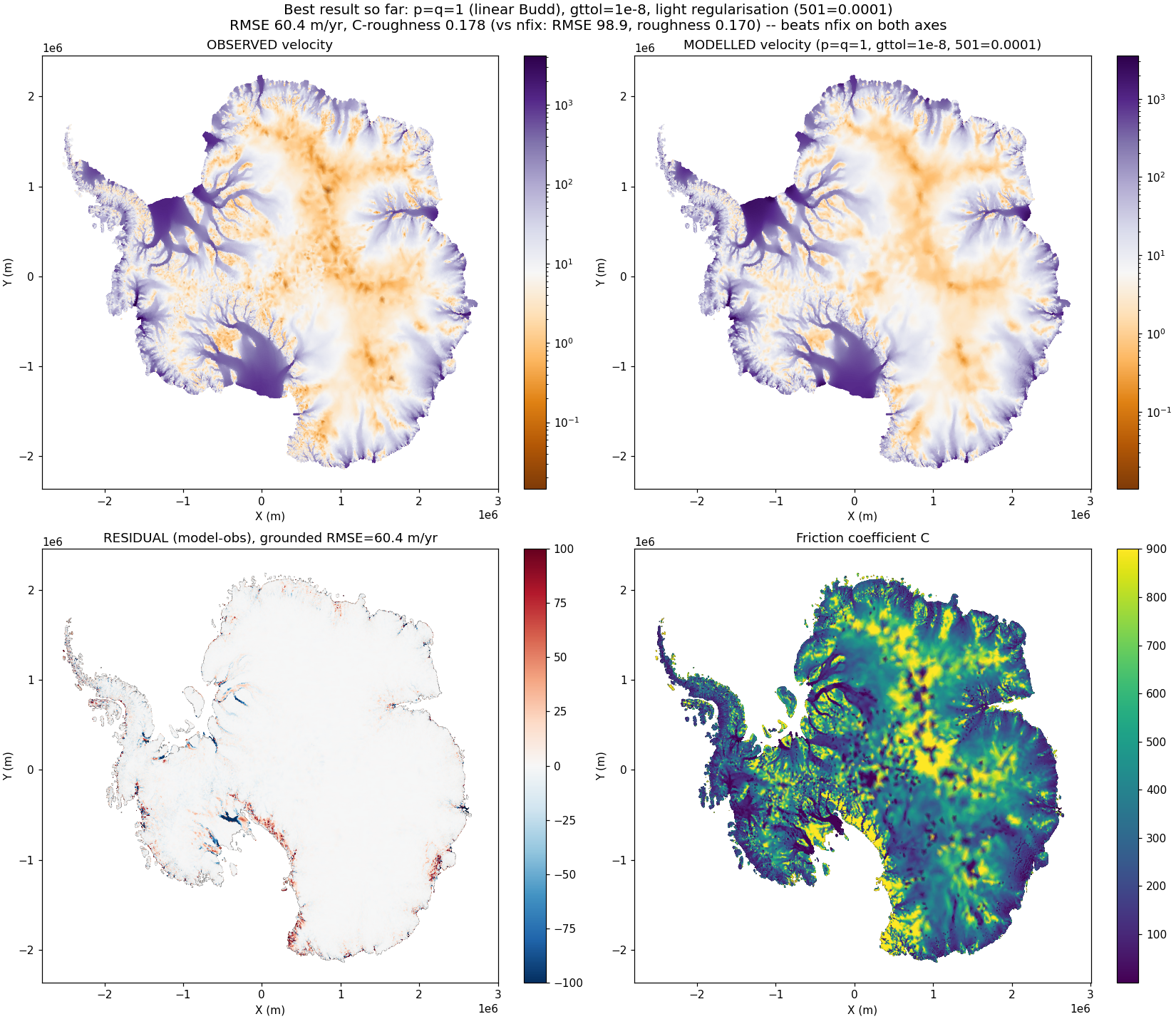
The present-day state is no longer effectively static: the main initialization and inversion failures have been isolated, repaired, and tested. The current production state uses Schoof friction at 70.43 m/yr grounded RMSE and is verified converged in practice. A reproducible, fully converged Budd state reaches 98.9 m/yr, while a promising 60.4 m/yr Budd result still needs validation through the production pipeline. The latest pipeline update validates the SSA historical run at 1.402 m/yr dH/dt RMSE; the HO historical run continues through chunked warm restarts.
Full higher-order thermal solve converged and produced AIS3_thermal_steadystate.nc, with post-solve temperature safeguards and rheology recomputation.
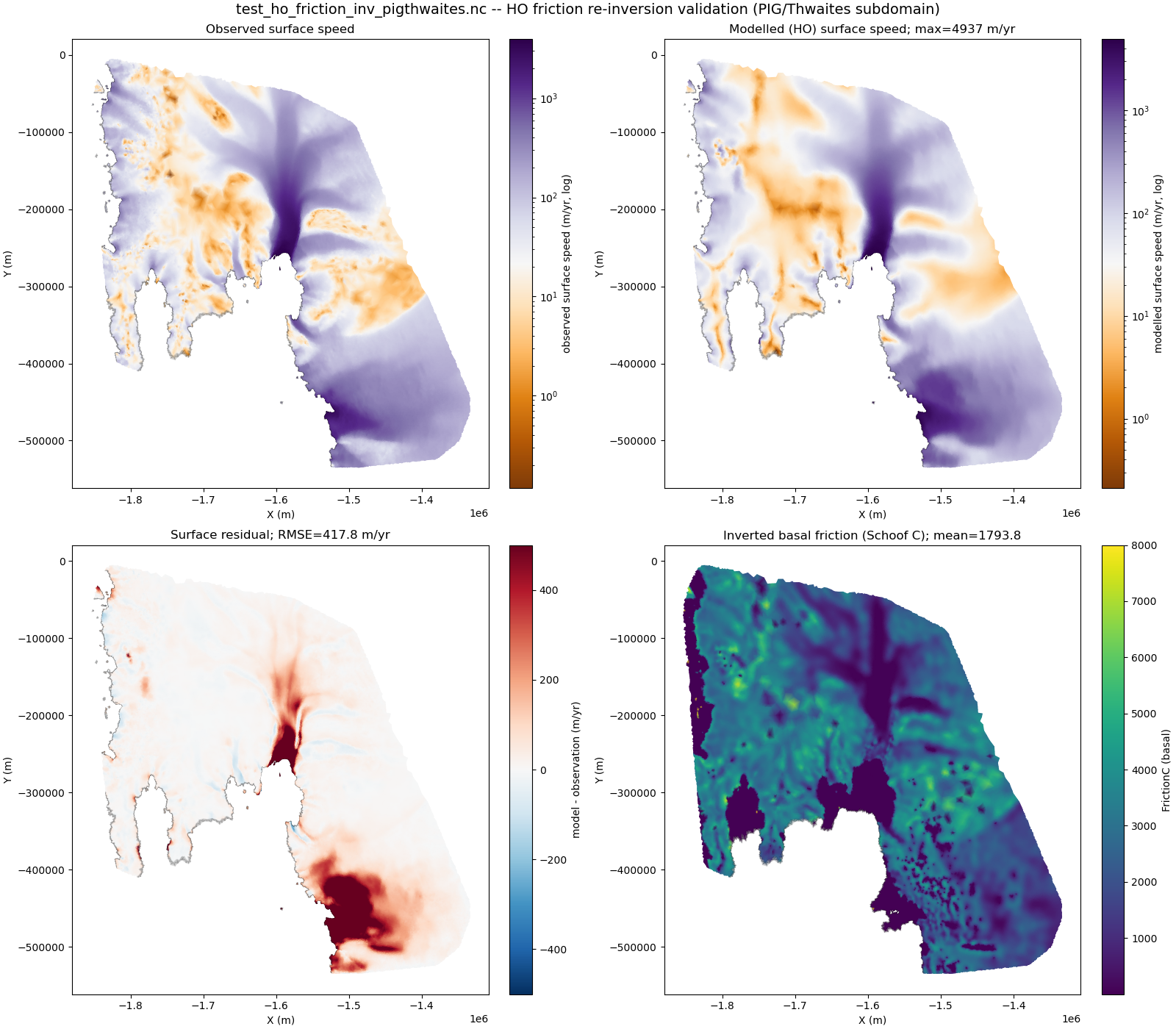
Chunked continuation reached a stable checkpoint, but chunk 4 failed five times with two failure signatures. The continuation is paused pending a better diagnosis.
SSA historical tuning is complete at 1.402 m/yr dH/dt RMSE. The HO track is still running in six-year warm-restart chunks; the melt calibration is finalized at gamma_0=300 with basin refits.
| Configuration | Grounded RMSE | What it means |
|---|---|---|
| Null model | 310.6 m/yr | Baseline to beat |
| Original setup | 323.5 m/yr | Model was effectively static |
| Friction-only, 200 iterations | 110.6 m/yr | 83% within 50 m/yr |
| Schoof, AIS3_inverted.nc | 70.43 m/yr | Current production state; converged in practice |
| friconly_nfix, Budd p=q=3 | 98.9 m/yr | Best validated, reproducible self-consistent SSA result |
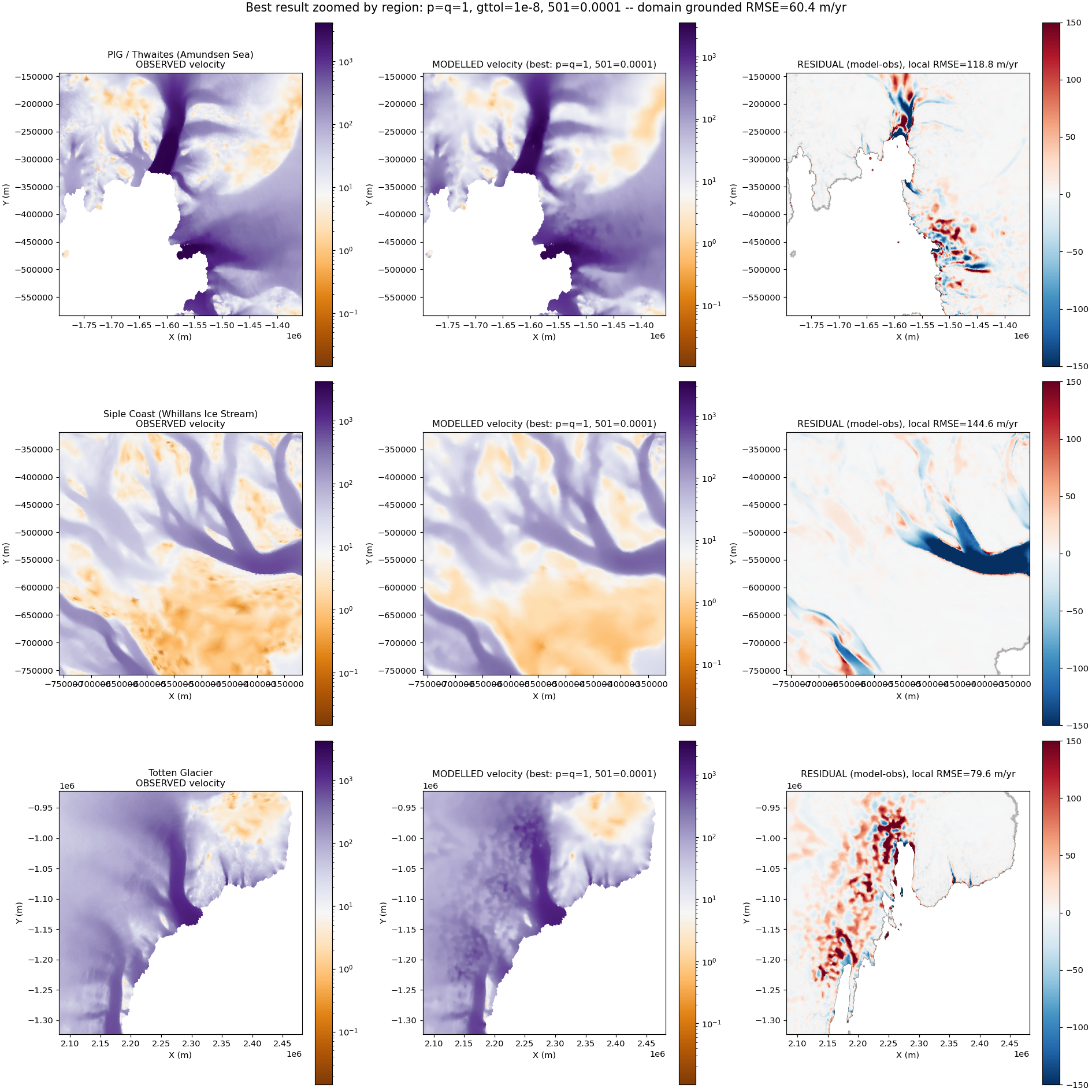
| Budd p=q=1, regularised | 60.4 m/yr | Best RMSE found; not yet validated through the production step |
| Forward-only damage-relaxed shelf B | 67.3 m/yr | Not self-consistent; does not survive re-optimization |
The Budd initial coefficient was moved from 100 to 1.8, where the inversion has useful sensitivity. The former results were discarded because the model was not moving.
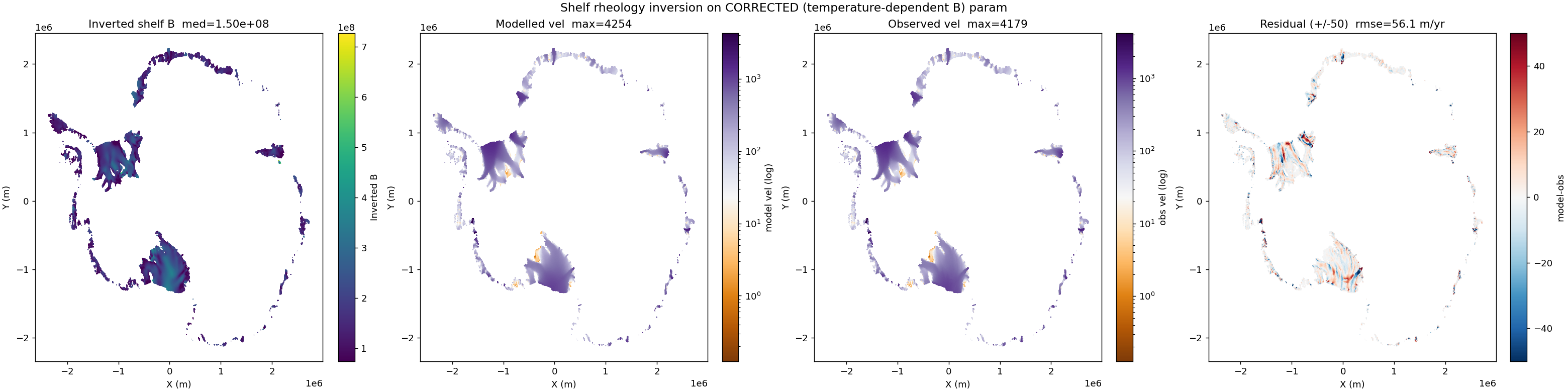
Uniform placeholder B was replaced with a RACMO surface-temperature-derived field. The temperature remains a proxy for depth-averaged rheology, but it restores the missing spatial variation.
The drag mask is vertex-based, and the floating calving front is cleared back to Neumann conditions after extraction. This avoids stripping drag from grounded ice and avoids an artificial velocity clamp at the front.
Experiment scripts rebuilt the surface after applying a thickness floor, fabricating steep slopes and driving stress. Production now preserves the observed surface and absorbs the floor into the base.
The HO historical run now advances in six-year warm-restart chunks, recomputes geometry to enforce base-above-bed consistency, and leaves extra wait-time margin for hugemem queue congestion. The SSA track is complete and validates at 1.402 m/yr dH/dt RMSE.
| Stage | Step name | Status | Output |
|---|---|---|---|
| 1. Thermal spin-up | ho_thermal_steadystate | Validated | AIS3_thermal_steadystate.nc |
| 2. HO friction inversion | ho_friction_inv | Paused after repeated chunk-4 failures | AIS3_ho_friction_inv.nc |
| 3. Melt calibration | melt_gamma_tuning | Finalized; naive RMSE invalid | gamma_0=300 with basin refits |
| 4. Relaxation | ho_relaxation | Completed solve; output salvage/qualification required | AIS3_ho_relaxed.nc |
| 5. Historical tuning (HO) | historical_dhdt_tuning | In progress; chunked warm restart | AIS3_historical_1995_2019.nc |
| 5. Historical tuning (SSA) | historical_dhdt_tuning_ssa | Complete and validated | 1.402 m/yr RMSE |
| 6. Future projections | projection_ssp | Scaffold | AIS3_projection_{gcm}_{scenario}.nc |
Scaffolded stages intentionally retain explicit TODOs for unresolved science choices. Their intermediate outputs must not be treated as validated results.
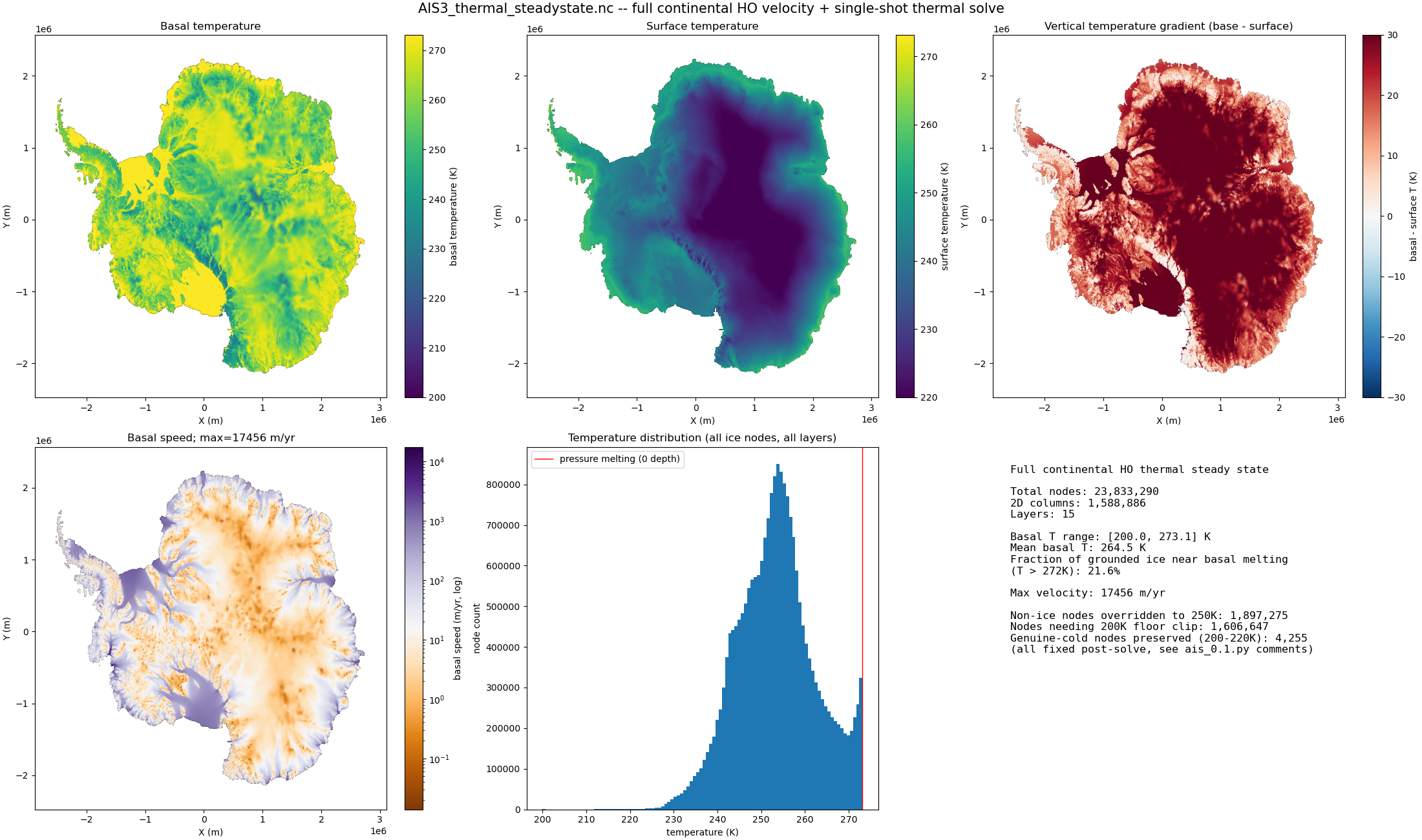
AIS3_thermal_steadystate.nc. Open full resolution